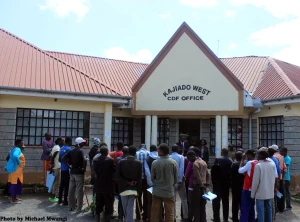
Kibiku residents considering a divorce from Kajiado West

A section of Kibiku residents in Kajiado West are considering a divorce from Ewuaso Kedong Ward and Kajiado West sub county to move to Kajiado North sub county. Some Kibiku residents feel ignored especially by the Ward county assembly representative Joseph Tores Other residents however disagree with the proposal of a divorce. “Changing constituency without changing the bad habits of our leaders will not make any difference” Joseph, a resident of Kibiku said The residents feel the road infrastructure should be commensurate to the raw materials being mined at the vet farm and exported elsewhere.

Read Full News

How traditional culture may compromise transparency and accountability

The problem of water scarcity affects many areas across the country. Reasons for the scarcity may range from lengthy periods of drought in some of the arid and semi-arid regions to mismanagement in the delivery of water services in the urban areas. In Kisamis, a small, quiet town in Kajiado County about one-and-a-half hour’s drive from Nairobi on the way to Lake Magadi, water source management is one of the sticking issues requiring urgent attention. Located in the expansive Keekonyokie Ward, Kajiado West Sub-County, the situation is such that it has bred a simmering conflict that is threatening to tear the local community apart pitting the youth against their elders. Robin ole Kurenta, a human rights activist working with End Poverty with Justice Initiative (EPJI) in the town, offers an illustration that aptly sums up the history surrounding the issue. The conflict, he explains matter-of-factly, is symbolised by a water-dispensing point that has scandalously stood in prolonged disuse at the shopping centre. The town has been experiencing water shortages for a number of years, mainly due to negligence bordering on corruption, as claimed by some residents, including vandalism and local politics. It was hoped the stalled project would become operational with the re-launch of the water point, marked by the laying of the foundation stone for a permanent structure by the local Member of County Assembly in February 2018. The now completed stone structure housing the water point appears like a white elephant, standing out like a monument in the middle of the town symbolising the unresolved issues in its idleness. When I visited the town at the end of September 2018, it was to probe the claimed lack of accountability in the water fuelling the misunderstanding. My interest was informed by the principle that accountability implicates basic governance issues such as transparency, even at the lowest level within a family or a community-based project. At the larger ward and sub-county level, it was apparent the local administration was seized of the matter, whom the youth had expressed their grievances and delivered a raft of demands. This is given credence by the kitty set aside from the ward development fund towards the water project. This suggested that, if there was an issue stalling the project, the blame lay elsewhere other than merely with the local ward administration. The apparent cause of conflict was articulated by Joel Shongo, one of the youth harbouring a grievance. “The problem,” he charged, “originates from the fact that our fathers have denied us a chance at managing the project.” He expressed opinion that “si mambo magumu yanafanya hii mashida iwepo. Ni mambo ya uongozi (it’s not something so difficult that we should be having such problems. It has to do with leadership).” For this reason, the youth seek to be accorded responsibility to manage the Keekonyokie water project taking over from a section of their elders, who “since we were born have ineffectively” comprised the management committee. Though the issue may be about leadership, it is also a bit delicate. Steeped in cultural tradition, the elders’ persistent reluctance to cede the responsibility to the youth becomes apparent, as Robin, the resident human rights activist, points out. “It’s about our still prevalent traditional customs,” he explains. “Among the Maasai such issues go na kiriika (social stature accorded to age groups). There’s an age at which as youth you cannot question an elder, whatever mistake may have been committed. Doing so may be viewed as a gross cultural insubordination risking a serious curse.” The residents I spoke with agree with Robin, with the implication being that nothing may dethrone the elders other than death. With such an explanation it illuminates how, inadvertently or not, and not just in Kisamis but among other “traditional” communities, some persistent cultural mores may compromise accountable leadership and, by the same token, transparency on how resources are managed. Being denied an opportunity to question a transgression removes the opportunity for dialogue or finding a compromise solution. I spoke to an elder pointed out to me as a member of the water project management committee. While he did not deny the place of elders and leadership as culturally demanded in the community, he seemed to have a dim opinion of the local youth who he accused of idling in the shopping centre getting high on drugs and alcohol. He did not view them as able to handle serious responsibility. Pressed to clarify whether it applied to all the youth in the area as “irresponsible”, he conceded that those with the will to take up project leadership should present themselves. This is despite the aforementioned youth demands lodged with the local administration. Mzee Koitawash ole Olorong’oto, who is not a member of the committee, was more positive. Citing his advanced age as a badge of authority equal to that of his peers, he was insistent the youth be accorded the opportunity to take over the project management. They have what it takes, he said, if not more qualified given their level of education. However, the negative cultural hold on the community was further illustrated when I approached local women for a comment, but who declined to speak. I would later learn that those who had offered to be interviewed and descended from the area had changed their mind after being cautioned by their husbands not to speak on the water issue “or they will face it at home.” Likewise, though acknowledging the water problem, women immigrants doing business at the shopping centre would also not speak on the record fearing reprisals. The complexities of trying to resolve the negative aspects entrenched in the culture have clearly also not left officials at the local administration unscathed – more so the chiefs descended from the area. It was evident the difficulty has somewhat compromised their authority in the whole situation. This is understandable, as applying too strong an authority to force a solution or going about it too quickly may counterproductively unravel the socio-cultural structure that binds…


Read Full News

Ngong Town Poor Drainage System

  The recent floods have left many business owners in Ngong Town with no option but to dig trenches in front of their shops. Mutung’u Mutunga who operates a Chemist came together with other businesses owners contributed to pay labourers to dig a trench and put up sandbags to keep flood water at bay. “The county government is loosing much needed revenue since no vehicle currently can park here.  It’s not our wish to dig a trench, but we have no option at the moment! we must protect our investments”. He said

Read Full News

Update on the status of the two Million Shillings Allocated Towards Hilltop Bridge

Prior to the controversial bridge which was recently built at Hilltop Road by the firm building the SGR, Kajiado North CDF had allocated 2 million shillings towards the same bridge. The money was deposited in the account of Hilltop Road Community (CBO) at Equity Bank. Shortly afterwards, Ksh500,000 of the 2 million shillings was allocated towards the urgent construction of Kangawa bridge under instructions of Kajiado North member of parliament Joseph Manje.  During a meeting held at Kenvic School off Zambia Road, Hilltop and Penny Road, stakeholders agreed to use the remaining 1.5 million shillings to install solar street lights along Hilltop Road and Penny Lane. According to Mr Njuguna who is the Chairman of the CBO, after receiving several quotations, the money was enough to install 20 solar street lights, which uses Lithium batteries with a guaranteed lifespan of 5 years.  He forwarded his quotations to the CDF office in order to get a go ahead.  Unfortunately, he was told the CDF manager had given instruction the money could not be approved. Following our enquiry, Ngong CDF office staff told our reporter, the money is still in the bank but has since been allocated towards the construction of 2 rooms and a toilet at Olepolos AP Post.  The staff further said CDF only funds security projects and education.  He concluded by saying street lighting is a function of the county government. Our reporter spoke to Mp Manje today in the afternoon and indeed he confirmed the money has been allocated towards Olepolos AP post.

Read Full News

Residents living near hilltop bridge panics due to flooding

Hill top bridge which was built recently blocked following heavy rainfall on 11th April 2018, causing serious flooding that affected those living nearby.   Iddi Maguna who rents in a nearby plot was at home with his wife and their one year old child when their house flooded.  They incurred losses of over Ksh100,000.   Mr Wangurumo who is landlord and lives with his wife and children said the floods caught them by surprise.  “The volume of water was so much we couldn’t even open the door.  We were trapped inside leaving my wife traumatized.  Luckily our sons who live nearby in the same compound came to our rescue.”  He said Their household goods and documents got soaked completely.  The floods damaged his car and is worried the vehicle may require an engine change   He estimates to have incurred losses of over half a million shillings. The whole family spent the night outdoor.   In a nearby property known as Sudbury Homes, Robert Nyambabi who is the caretaker and lives with his wife and child, raised the alarm to wake the tenants who were asleep at around 10pm. Some of the units got flooded completely. Mr Kangwana who is the owner of Sudbury Homes said hilltop bridge must be demolished and built newly to prevent future flooding which can turn tragic. Another landlord who wished to remain anonymous said the community had raised the issue with the contractor and the local engineers who were in charge of supervision, unfortunately their concerns were ignored.  He further said even though the road was a gift by the contractor, residents opinions should have been taken into account because they know better. The bridge was built by the Chinese firm building the SGR. Karen who lives with her sister and brother said she incurred losses of over Ksh25,000.  She told our reporter she almost drowned when she attempted to leave the house.  Her house is approximately 25 meters from the bridge.

Read Full News

Rain Brings Misery Instead of Hope

Many residents in Elpaso were unable to access their homes following floods along the Zambia to Hilltop murram road next to the river. Some of the residents risked their lives by walking through the flooded road.  Others including a pregnant woman had to climb through a neighbor’s walls to access their homes. In Ngong Town, business owners arrived to open their shops as usual only to find them flooded.  Selestine who sells animal feeds told our reporter she incurred a loss of approximately Ksh30,000.  This is not the first time her shop has flooded. Musa who sells animal feeds as well, said he incurred a loss of approximately Ksh50,000 overnight due to the floods. Musa further said “I pay Ksh12,000 annually to the County Government as license fees, but the service we are getting from the County Government is not sufficient”.   Musa further asked “Are business people going to stop running their businesses to build and manage a drainage system because the County Government has failed?” Abdir Hassan who is a business man in Ngong Town said he spent the whole night awake and standing trying to stop the flood water from entering his house but he didn’t succeed.  He had to break a wall in his office for the flood water to exit to avoid a disaster. Samwel Mungai Kiambuthi who is a landlord in Ngong Town said this annual issue of floods has really affected business along the road next to Ngong Hills Plaza.  He further said “no customer wants to walk on such a muddy road” According to Jacob Karanja, the flood water flows from the hills via the ministry of works access road through the town.  Karanja further said, if the county government wants to solve the problem, they can easily redirect the water towards vet farm.  He claimed there used to be a “mzungu” who used to work for the ministry of works in the 90s, who had redirected the water towards Vet farm, but the culverts are now blocked. Karanja concluded by saying it is possible to do the same by simply digging a reasonably sized trench.   Jacob Saruni who lives in Kibiku and works in Ngong urged the County Government to dig dams in Vet farm to harvest the rain water. One of the main agendas  by Kajiado County Governor Hon. Joseph Ole Lenku in dealing with water shortages  is harvesting water from the hills. The drainage trench next to Mubarak Food Court is risking the stability of the hotel building.  According to Omar, the trench was dug as a temporary alternative of the old sewer line which had blocked. He requested the County Government to address the issue as soon a s possible. Most people our reporter spoke to wanted the issue to be tackled from the source of the flood water. Other residents said encroachment into the riparian land is also part of the problem.  They suggested the County Government mark out the boundaries of private land and the riparian land.  

Read Full News

Mau Mau Veteran Lives in Absolute Poverty

Beatrice Wanjiku Ndung’u who lives in Laini Saba, Matasia with her son and grandchild, is a member of the mau mau veterans Association.  Wanjiku was born in 1946 and claims to have participated in the mau mau rebellion as a young girl during the 1950s.  She told our reporter her service towards independence of our country was to deliver food to the freedom fighters like many other young girls during the emergency period.  She narrated to our reporter how her sister the late Mary Wairimu was shot in the leg in 1952 and got her leg amputated.  Her brother was also part of the mau mau freedom fighters. Wanjiku whose house floods every rainy season expressed her frustrations with the poverty she lives in even though she risked her life for the independence of our country. “I live in absolute poverty in animal like conditions! I would like to live like a human being! With dignity! And proud to be Kenyan!”  She said The official number of Mau Mau killed was 11,000, with over 1000 hanged by the British administration.  The Kenya Human Rights Commission has said 90,000 Kenyans were executed.  The emergency war started in 1952 and ended in 1960.

Read Full News

Residents Claim 13 Million Shillings of Public Funds Wasted

Matasia dam which is commonly known as “Esilanke” has burst its banks, barely 12 months after rehabilitation works was completed.  According to a former project oversight committee member, the dam which was rehabilitated at a cost of Ksh13 million. Elveza Media published a story last year of some residents expressing their concerns over the safety of those living downstream incase the inevitable collapse of the dam happened.   Some of the elders our reporter spoke to but did not wish to disclose their identity and use the public land next to the dam for cultural activities, expressed dissatisfaction with the quality of work which was done. The project was executed by Dido and Sons Ltd and commissioned by the State Department of Irrigation as part of Kenya Vision 2030.  The elders together with some area residents our reporter interviewed, requested Kajiado North member of parliament Joseph Manje to release a statement over the status of the project.

Read Full News