By Amy Moyi
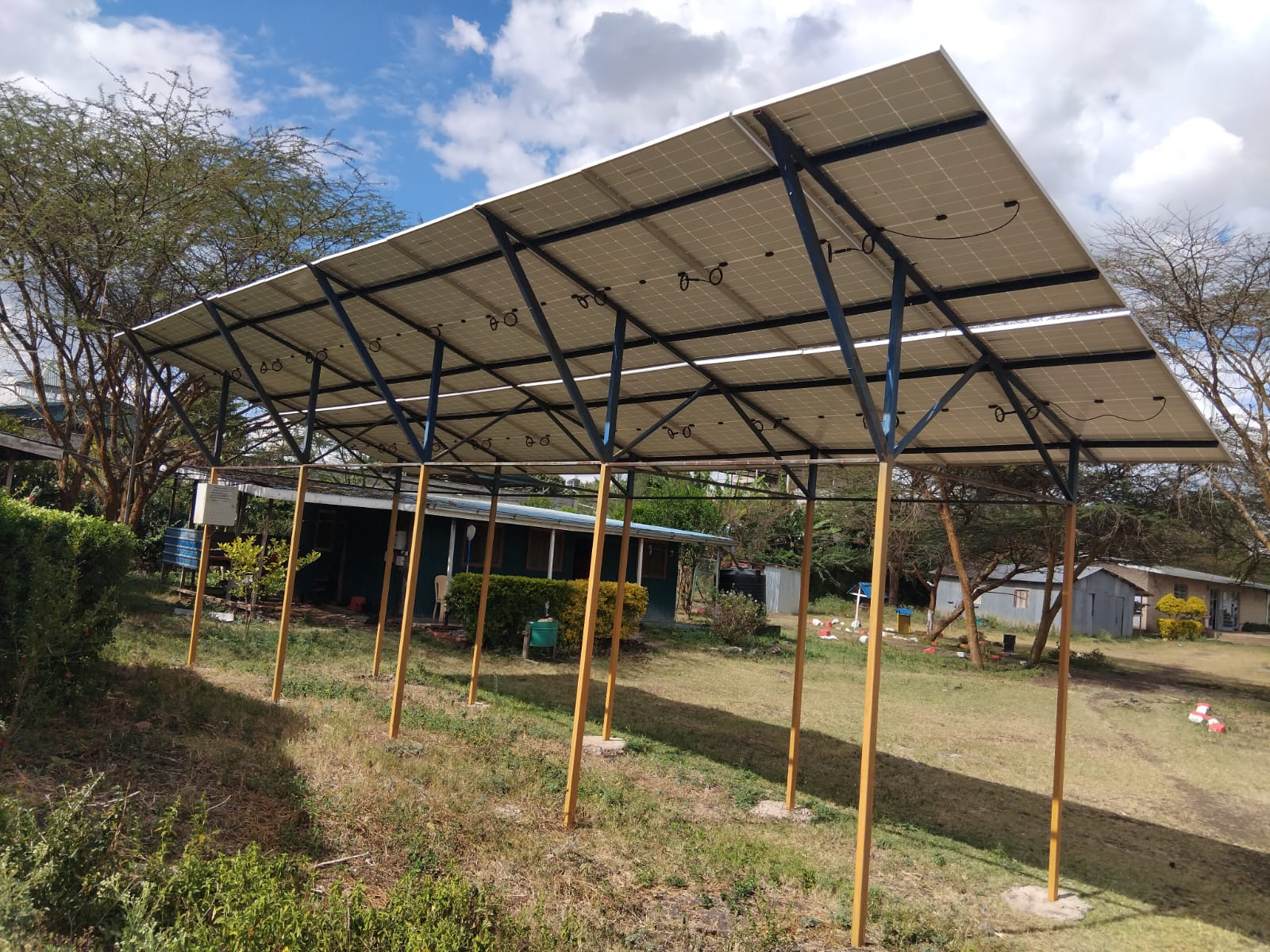
When Agrovoltaics (AV)—a method of growing crops under solar panels—was first introduced in Kenya in 2022 at Latia Agribusiness Solutions in Kajiado County, it began as a trial, with scientists and farmers hoping the project would improve agricultural production in the country’s Arid and Semi-Arid Lands (ASALs).
Three years later, the technology is proving its value, strengthening food production while providing a reliable source of renewable energy.
A collaboration between the University of Sheffield, World Agroforestry, and Latia Agribusiness Solutions, the project is demonstrating how solar panels can serve a dual purpose—generating electricity while optimizing crop-growing conditions.
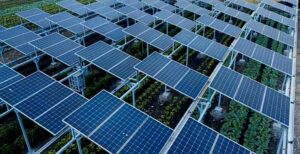
The concept, often referred to as ‘Harvesting the Sun Twice,’ reduces heat stress on crops, minimizes water loss, and boosts overall yields.
“The agrovoltaics system has nearly halved our monthly electricity costs—from KES 150,000 to KES 80,000,” said Charles Macharia, the manager at Latia Agribusiness Solutions.
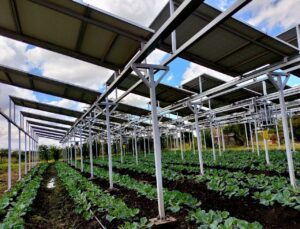
Beyond reducing energy expenses, Macharia noted that the system is playing a crucial role in water conservation—an essential advantage in Kajiado’s dry climate.
“The solar panels are designed with gutters that collect rainwater, which we store in tanks for irrigation,” Macharia said, “This has significantly cut our reliance on other water sources and lowered irrigation costs.”
At the Latia farm, 180 solar panels, each generating 345 watts, are elevated three meters above the ground. This design allows sufficient sunlight and rainwater to reach the crops while shielding them from extreme temperatures.
The institution has observed improved growing conditions for maize, lettuce, kale, eggplant, and cabbage.
“Preliminary observations suggest that crops grown under the solar panels are healthier and more robust compared to those in open-field control plots, even when provided with the same amount of fertilizer and water,” said Judy Wairimu, an agronomist at Latia Agribusiness Solutions.
“For example, cabbages grown under the panels have been recorded to weigh up to five kilograms, whereas those in open fields typically reach around two kilograms,” she added, noting that the difference may be due to reduced heat stress, improved soil moisture retention, and more stable temperature conditions.
Latia is not only implementing agrovoltaics on its farm but also training farmers across Kenya on its benefits and practical applications.
Anne Watkins, a farmer from Kajiado county is among those who have undergone training.
“I never imagined solar panels could help with farming,” she said. “Now I understand how they reduce heat stress on crops and save water. I plan to try this on my farm, ” Watkins said
However, Anne Watkins says the initial capital required to install the agrovoltaics system is a challenge that has limits farmers who want to adopt the system.
“The cost of installing the agrovoltaics system is too high for many farmers like myself . The government can assist by providing low interest loans to groups of farmers to enable them to install it and reap its benefits,” added Watkins.
Dr. Richard Randle Boggis, a research associate at the University of Sheffield, pointed out the need for localized testing of agrovoltaics to assess its potential in strengthening climate resilience and improving food security, particularly in rural and ASAL regions.
“We needed to build a test system to see if this technology is suitable for the region,” Dr. Boggis said during a field visit at Latia Agribusiness.
A study published in Nature – a scientific journal— showcases agrovoltaics as a promising solution for land-use efficiency, suggesting that dedicating just 1% of the world’s arable land to solar energy production could meet global energy demands.
Additional research indicates that the electricity generated from solar panels can increase the economic value of agrovoltaic farms by more than 30%.
These studies position Agrovoltaics as a promising solution to challenges faced by rural farmers, including land scarcity and rising energy costs, with the ability to combat climate change by reducing greenhouse gas emissions by generating renewable energy.
However, the high initial investment required for agrovoltaic systems poses a significant barrier to widespread adoption.
These systems often entail higher construction costs compared to conventional ground-mounted solar installations, primarily due to unique installation requirements.
Agrovoltaic farming system, is slowly gaining traction in Kenya. Aggie Konde from the Alliance for Green Revolution in Africa has said that there is growing interest in integrating renewable energy technologies into Kenya’s agricultural sector to enhance productivity and promote sustainability.
“Over the last twenty to thirty years, players that have been in the agricultural ecosystem have put the foundation on why agribusiness is viable for the continent. We know which technologies have a chance of success on the continent,” said Konde.
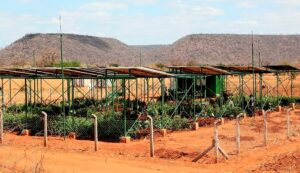
While Latia Agribusiness Solutions was the first to implement the technology, a second project—the Ngomano Agrivoltaic Project in Makueni County—has also adopted the approach. Though still in its early stages, this expansion reflects a growing interest in solar-farming systems as a way to boost agricultural productivity and renewable energy access, creating new opportunities for farmers across Kenya.
Initial trials at Ngomano have yielded promising results. According to Eytan Hatzor, a representative from Israel’s Agency for International Development Cooperation -also known as MASHAV- tomatoes, okra and cabbages grown under the shade of the solar panels have produced better yields in comparison to those grown in the open fields.
In addition, local farmers in Ngomano have been able to grow crops through irrigation using water collected through the agrovoltaic irrigation system.
“One of the reasons we started the project in the area is because the local community is taking part. They have their own field and get the advantage that part of the project is to bring water. The project has also combined production of electricity through solar energy with agriculture,” said Hatzor.
The Ngomano project was launched through the collaboration of the Jewish National Fund-USA, the University of Arizona and the Kasser Joint Institute for Food, Water, Energy, and Security in Arava Valley, Israel.
Hatzor has said that although the project has great potential for successful implementation in semi-arid areas like Makueni, initial installation cost is a challenge.
“Agrovoltaics has been successful in countries like United States of America. However, there are some improvements that can be made to reduce the installation costs. It is important to determine if the increased yields will cover the installation costs,” added Hatzor.
At Latia, the agrovoltaic system is currently powering farm operations, and its success in the dedicated section of land has sparked discussions about expansion.
According to the institution’s manager, the plan is to scale up the system to supply energy to the entire institution while incorporating solar energy storage as a backup for power outages.
“With sixty acres of land still available, expanding our agrovoltaic system will help us meet our growing farming and energy needs,” Macharia said.
This story was produced with the support of the African Centre for Media Excellence (ACME) in partnership with the Charles Stewart Mott Foundation