Last year a young passed away in Gichagi, Ngong which is nowadays known as Uplands. He left behind his only family member, his brother. They were both orphans and not financially well off. Several women mobilized other women from the community who all decided, to assist with the wake and funeral expenses.
Mr Kimotho leading the prayers to bless chairs bought by the women recently.
The young man was buried and shortly afterward, a new community women group was born. The group which is known as Gichagi Mwaki Women Group was specifically formed to assist members in-case of emergencies such as death. Each member contributes Ksh120 and a piece of wood. The cash is used to cover funeral expenses and the firewood is used during the wake to cook food and tea. The firewood also is used to make fire, to warm those who stay late, with the deceased family for companionship.
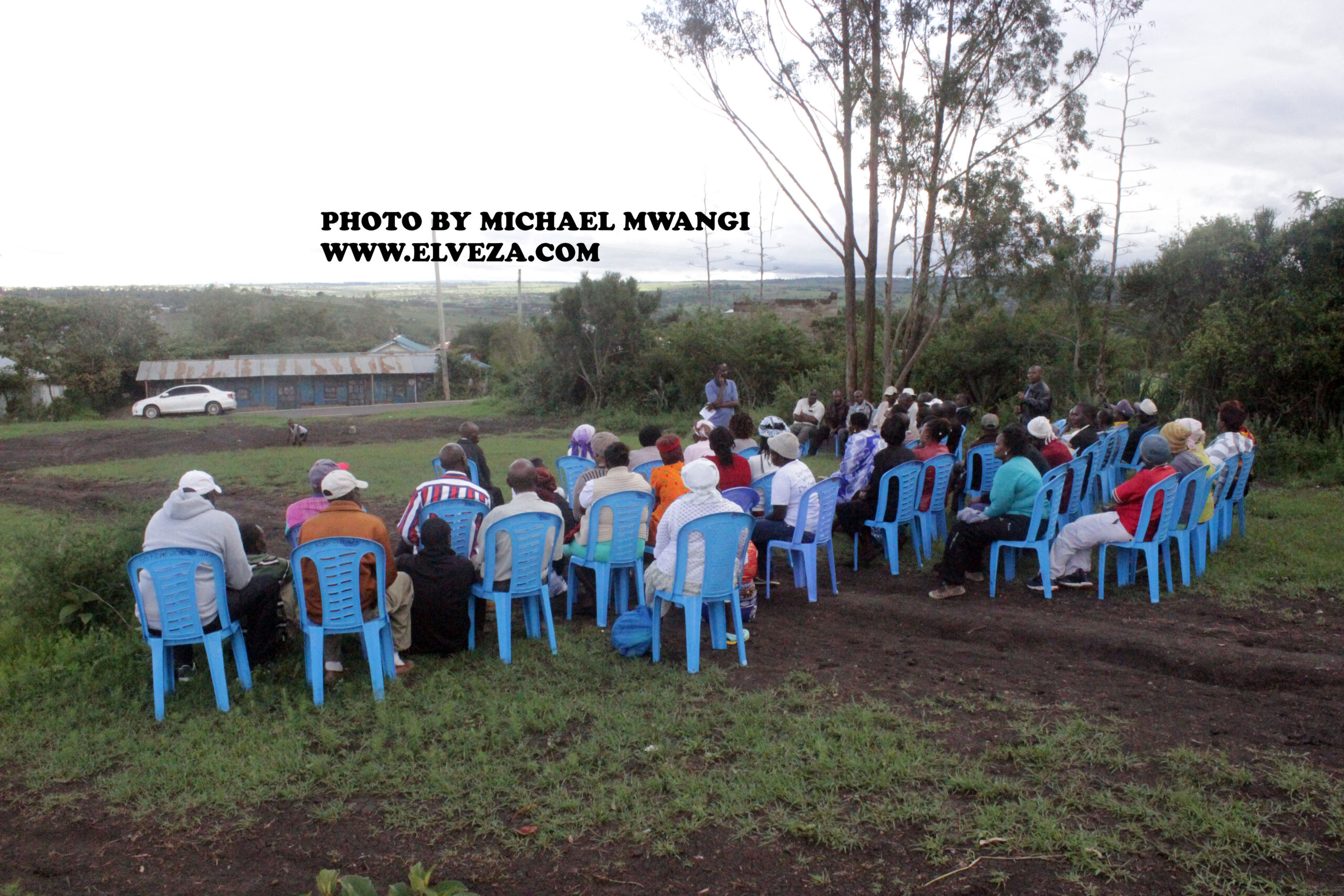
The group recently managed to purchase 145 chairs and are planning to purchase a tent. This is a good investment according to the area residents since the residents now have chairs to sit on during community public meetings. Each member had contributed 150 shillings towards the purchase of the chairs.
Area leaders including the Chief and the Chairman came to support the women
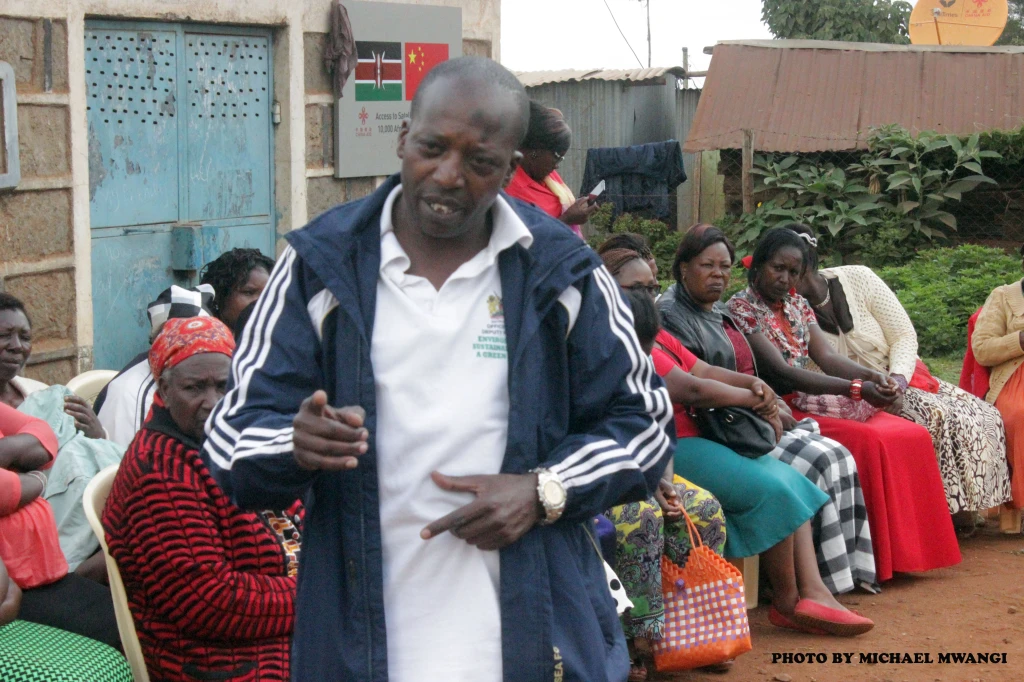
Mr Kimotho who is a resident of the area requested the men to support the women wholeheartedly. He said the women are showing leadership never seen in the community before.
Ngong Ass. Chief George Kimemia yesterday gave a stern warning to criminals operating within his area of jurisdiction. The chief requested mothers to talk to their sons who are engaging in criminal activities to stop immediately. He said he has done everything possible to influence change to those engaging in crime, but some have refused to change.
The Chief concluded the security message by declaring that he has washed his hands, and from now onwards, he should not be blamed for whatever happens to those engaging in crime. Residents of Ngong have been complaining about a rise of insecurity cases in the last two months.
The Ass. chief also advised the residents to subscribe to NHIF to cover themselves, in case of medical emergencies. He also requested a united development dialogue of all residents within Gichagi and especially those living next to the roads. The dialogue is meant to find a solution to the narrow roads within the area. The Ass. Chief said the area can also benefit from tarmac roads like other areas, but the area roads must meet the minimum roads standard.
Ass. Chief Kimemia was speaking yesterday during a meeting organized by Gichagi Mwaki Women Group.
By Gitura Mwaura (Author and Development Journalist Working Across East Africa)
The problem of water scarcity affects many areas across the country. Reasons for the scarcity may range from lengthy periods of drought in some of the arid and semi-arid regions to mismanagement in the delivery of water services in the urban areas.
In Kisamis, a small, quiet town in Kajiado County about one-and-a-half hour’s drive from Nairobi on the way to Lake Magadi, water source management is one of the sticking issues requiring urgent attention.
Located in the expansive Keekonyokie Ward, Kajiado West Sub-County, the situation is such that it has bred a simmering conflict that is threatening to tear the local community apart pitting the youth against their elders.
Robin ole Kurenta, a human rights activist working with End Poverty with Justice Initiative (EPJI) in the town, offers an illustration that aptly sums up the history surrounding the issue.
The conflict, he explains matter-of-factly, is symbolised by a water-dispensing point that has scandalously stood in prolonged disuse at the shopping centre.
The town has been experiencing water shortages for a number of years, mainly due to negligence bordering on corruption, as claimed by some residents, including vandalism and local politics.
It was hoped the stalled project would become operational with the re-launch of the water point, marked by the laying of the foundation stone for a permanent structure by the local Member of County Assembly in February 2018.
The now completed stone structure housing the water point appears like a white elephant, standing out like a monument in the middle of the town symbolising the unresolved issues in its idleness.
When I visited the town at the end of September 2018, it was to probe the claimed lack of accountability in the water fuelling the misunderstanding.
My interest was informed by the principle that accountability implicates basic governance issues such as transparency, even at the lowest level within a family or a community-based project.
Youth presenting their grievances to Kajiado West Deputy County Commissioner William Kakimoi.
At the larger ward and sub-county level, it was apparent the local administration was seized of the matter, whom the youth had expressed their grievances and delivered a raft of demands.
This is given credence by the kitty set aside from the ward development fund towards the water project.
This suggested that, if there was an issue stalling the project, the blame lay elsewhere other than merely with the local ward administration.
The apparent cause of conflict was articulated by Joel Shongo, one of the youth harbouring a grievance.
“The problem,” he charged, “originates from the fact that our fathers have denied us a chance at managing the project.”
He expressed opinion that “si mambo magumu yanafanya hii mashida iwepo. Ni mambo ya uongozi (it’s not something so difficult that we should be having such problems. It has to do with leadership).”
For this reason, the youth seek to be accorded responsibility to manage the Keekonyokie water project taking over from a section of their elders, who “since we were born have ineffectively” comprised the management committee.
Though the issue may be about leadership, it is also a bit delicate. Steeped in cultural tradition, the elders’ persistent reluctance to cede the responsibility to the youth becomes apparent, as Robin, the resident human rights activist, points out.
“It’s about our still prevalent traditional customs,” he explains. “Among the Maasai such issues go na kiriika (social stature accorded to age groups). There’s an age at which as youth you cannot question an elder, whatever mistake may have been committed. Doing so may be viewed as a gross cultural insubordination risking a serious curse.”
The residents I spoke with agree with Robin, with the implication being that nothing may dethrone the elders other than death.
With such an explanation it illuminates how, inadvertently or not, and not just in Kisamis but among other “traditional” communities, some persistent cultural mores may compromise accountable leadership and, by the same token, transparency on how resources are managed.
Being denied an opportunity to question a transgression removes the opportunity for dialogue or finding a compromise solution.
I spoke to an elder pointed out to me as a member of the water project management committee. While he did not deny the place of elders and leadership as culturally demanded in the community, he seemed to have a dim opinion of the local youth who he accused of idling in the shopping centre getting high on drugs and alcohol. He did not view them as able to handle serious responsibility.
Pressed to clarify whether it applied to all the youth in the area as “irresponsible”, he conceded that those with the will to take up project leadership should present themselves. This is despite the aforementioned youth demands lodged with the local administration.
Mzee Koitawash ole Olorong’oto, who is not a member of the committee, was more positive. Citing his advanced age as a badge of authority equal to that of his peers, he was insistent the youth be accorded the opportunity to take over the project management.
They have what it takes, he said, if not more qualified given their level of education.
However, the negative cultural hold on the community was further illustrated when I approached local women for a comment, but who declined to speak.
I would later learn that those who had offered to be interviewed and descended from the area had changed their mind after being cautioned by their husbands not to speak on the water issue “or they will face it at home.”
Likewise, though acknowledging the water problem, women immigrants doing business at the shopping centre would also not speak on the record fearing reprisals.
The complexities of trying to resolve the negative aspects entrenched in the culture have clearly also not left officials at the local administration unscathed – more so the chiefs descended from the area.
It was evident the difficulty has somewhat compromised their authority in the whole situation. This is understandable, as applying too strong an authority to force a solution or going about it too quickly may counterproductively unravel the socio-cultural structure that binds the community together.
The delicate situation notwithstanding, efforts are ongoing to find a solution in Kisamis. It, however, remains a matter of urgency for the local residents to have easily accessible and affordable water, as well as quelling the resentment between sons and fathers that continues to deepen the longer it takes to resolve the conflict.
I asked Jeremiah Supeyo, a thoughtful local teacher and youth leader who recognised it as a matter of accountability, about what should be done to find a lasting answer.
“I think it would be best,” he suggested, “if the local administration and the county government gets more involved in this, including involving the women, as well as the media to dig out the issues and highlight the concerns towards a solution satisfactory to everyone.”
Ultimately, it is not all about the negative. The Kisamis experience emphasises that some crucial aspects of our cultural heritage – both tangible and intangible – are still among us even in this digital age.
It also acknowledges the existence of positive mores (such as respect for the elders among other cultural aspects) that could still offer inspiration and learning to address community challenges.
The issue, therefore, is how these may be harnessed for grassroots development, including in transparency and accountability.
The Youth presented the following written proposals to the Kajiado West deputy county commissioner, William Kakimoi.
Removal and replacement of the current Kisamis borehole water project committee immediately. The group proposes for the new committee to be responsible in overseeing the current piping project and clearance of the electricity bill by the area MCA through the Emergency kitty from the office of Kajiado Deputy Governor.
Local youth to be given priority in employment during the piping works of the water project. That the contractor should only come with the Engineer with rest of the labor sourced from the community.
That all clusters propose names to a central organizing committee of 25 people from which, an executive committee of seven shall be elected to run the project for a period of five years which can be renewable.
That the theft of pipes by some individuals be reported for possible apprehension and recovery of the pipes.
That the pipe to take water from the borehole to the community tank should be 2″ in size and if possible have the plastic roll to contain the stealing of pipes in the future.
That an inventory of all water equipment, pipes especially those in the custody of the officials and those in water drinking points be done to facilitate proper water supply to all residents.
That a local restaurant they claimed uses the project water, should pay for water they consume as well as electricity.
A group of 2400 women from Olkeri Ward in Kajiado North constituency have launched a new brand of bread “OLKERI BREAD” in the highly competitive market. The group known as Olkeri Women Movers raised the seed capital through a contribution of Ksh150 from each member to establish the bakery.
The bakery which is located in Memusi, Matasia started production last week on Wednesday 19th September. According to the area MCA Peter Gitau who came up with the idea, the bakery sold 75 loaves of bread on the first day, 120 on the second day and 150 loaves on the third day.
Mca Gitau further said “we are targeting to sell 3000 loaves of bread per day in the near future. If we sell each bread at a wholesale price of 35 shillings, the bakery can turnover around 105,000 shillings daily or approximately 37 million shillings annually, generating a profit of approximately 17 million shillings”.
How will all the group members benefit from the business?
Gitau told our reporter that the startup does not have the capacity to employ each and every member currently, but the profits will be used to establish other cottage businesses until every member is economically empowered.
“We can for example, using the profits, fund a chicken businesses for some of the elderly members, who will supply eggs to the bakery. We may also consider using some of the profits to give bursary to all students from our ward ” Gitau said.
Why cottage businesses instead of focusing in building infrastructure such as roads?
The mca said “during the 2017 election campaigns, I conducted research and most people requested jobs as the first priority. As a leader I must therefore come up with revolutionary empowerment ideas such as the cottage industries, which will not only create sustainable jobs but empower people economically. We will still build roads.”
The MCA further said, the initiative is the beginning of a women led industrialization within Olkeri ward. The focus will be in the production of basic household commodities such as unga, soap and bread.
“Why can’t the women produce uniforms for all the schools in the ward?” He asked.
Critics
Gitau acknowledges he was putting his political career at risk when he decided to join hands with the women group to start the project. There has been criticism from some political opponents who are not happy with the MCA engaging in such projects and wished the MCA would focus on oversight and coming up with laws that will create enabling conditions for businesses.
Other critics are some of the spouses of the members who allege lack of transparency in the project. There were also allegations that the seed capital had been misappropriated, but the MCA rubbished the claims saying the rumors came up following unavoidable delays which were caused by the processes of obtaining the necessary documents such as VAT and other licenses to establish the bakery. “There are some who didn’t believe we could do it, the bakery is now open, and residents are buying the bread” Gitau said
Is there space for men and youth in the projects?
Gitau said the men will benefit greatly if their mothers, sisters, wife’s and daughter succeed. He further said the reason why he started with the women is because they are more organized, experienced and committed to such initiatives. “Majority of the women groups are managed using rules and constitution, which gives them an edge over men. The youth are already included since some of the members are under 35 years old ” He said.
Moving forward
Mca Gitau said, there will be regular monthly evaluation of the project as well as publication of accounts for transparency purposes. His target is to establish at least 20 jua kali industries within Olkeri ward to create approximately 1000 jobs before his first term comes to an end.
The group is targeting to recruit between 2600 – 3600 new members. Membership fee is 500 shillings per woman.
Views from some residents of Olkeri Ward
Mercy who lives in Matasia said “to stand out, the bakery should make bread which is different from the other similar products in the market.”
John who is a bodaboda rider said “I haven’t seen the bread yet. I will support the project completely if the profits will be used to improves lives in the community.”
Ngong Bus park will be closed temporarily until the Ngong Market project is completed. This follows appeals by the market traders who felt business will suffer when relocated next to the stadium. The traders have today told our reporters that their business and transport business depend on each other.
Passengers will now be expected to walk all the way to the stadium to board matatu’s. The move has excited businesses close to the stadium as they expect a boom due to the expected increase in foot traffic.
Ngong Market project will officially kick off on the 1st of May 2018 according to Peter Mwaura (Deputy Director, Social Infrastructure at Ministry of Nairobi Metropolitan Development.
The project will begin with the relocation of market traders to a designated site next to Ngong Stadium. Each trader will be compensated with Ksh15,000 in cash as disturbance allowance courtesy of Kajiado County Government.
Mr Mwaura was speaking at Ngong Stadium where validation exercise was taking place to identify genuine traders. Prior to today’s event, there were three conflicting traders lists i.e one from the world bank containing 1913 names, Kajiado county Government list containing just over 1400 names and the Ngong Market Committee list containing just over 1200 names.
To address the difference in the three lists, the World Bank, Kajiado County Government, Interior Ministry and Ngong Market Committee officials went though the three lists and approved 997 names as genuine traders as follows:
502 names appeared in the three lists
328 names appeared in Kajiado County and World Bank Lists
167 names appeared in the World Bank List and Ngong Market Committee lists
The remaining traders whose names appear in only one list will be vetted by all the officials. Mr Mwaura further said the project tender will be awarded latest next week. The whole project will take place within 12 months.
The National Land Commission was today the 17th April 2018 at the Chiefs Office in Oloolua to present compensation offer to those who will be affected by the SGR project. Today’s event was focusing specifically on those along the station corridor in Kangawa.
Those who accepted the offer had to sign confirming the agreement and were expected to hand over copies of their title deeds, pin certificate copy plus other documents to NLC Officials.
Our source claimed those along the station corridor will be compensated within a weeks time from today.
kahuho Ass. Chief Dancan L. Lanet has requested landlords who own rental properties in the area to collect a copy of ID from every tenant and also find out where the tenant moved from. The assistant chief was speaking during a ‘baraza’ held on 16th April 2018 in Kahuho.
“We will go door to door starting this week and check if landlords are collecting and keeping tenants data in the spirit of ‘nyumba kumi’ initiative. He warned those with empty properties to secure them properly since many residents are concerned criminals may be using the buildings as hideouts.
“Those who will not secure their empty properties risks getting them demolished.” He said
Residents who attended the meeting were shocked after a resident disclosed that there are women in the area who are peddling drugs.
“For a long time drug peddlers all over have been men but nowadays, women have taken over.” The man said
Those present requested the chief to address the drug issue as soon as possible and introduce the idea of information box to encourage members of the public to share sensitive information.
One day every year known as Good Deeds Day, thousands of people all over the world volunteer and help others. This year’s celebrations will be marked on 15th April 2018. The objective of the day is to embrace the idea of giving back to the society, improve the lives of others and positively changing the world. The day was initiated in 2007 by Shari Arison, an American born Israeli business woman and philanthropist.
Our reporter joined Forum for Women in Development, Democracy and Justice team on their visit to Cara Girls Rescue Centre in Kibiko today, a day earlier. The Centre focuses in girl child protection from cases such as early marriage and sexual abuse although they occasionally take boys. The team distributed Tshirts, food and sanitary pads.
The recently opened Matasia Health Care Facility will be more secure due to the ongoing construction of the security fence. The facility which is benefiting many people especially mothers who previously used to attend clinics in Ngong Town. It is a project of Kajiado County Government.