A woman who was arrested after allegedly spiking a couple’s drinks in a popular bar along Ngong to Matasia road has been remanded in prison after failing to secure a Ksh.150000 bond.
The woman is alleged to have been travelling all the way from Donholm, Eastlands, Nairobi county to specifically target men in bars.
Married men are said to be good targets for stupefying crimes because they will rarely want such information to reach their partners.
The woman is said to have been operating alone after falling out with her partner in crime.
According to section 230 of The Penal Code, any person who, with intent to commit or to facilitate the commission of a felony or misdemeanour, or to facilitate the flight of an offender after the commission or attempted commission of a felony or misdemeanour, administers or attempts to administer any stupefying or overpowering drug or thing to any person, is guilty of a felony and is liable to imprisonment for life.
Bar patrons have been urged to monitor their drinks keenly and ensure the bottle is empty before leaving the table at any moment.
In a major leap towards improving menstrual health and hygiene, Kenyan entrepreneurs Grace Amogola and Dr. Mary Odhiambo are introducing an innovative product designed to make periods more manageable, comfortable, and discreet for women and girls.
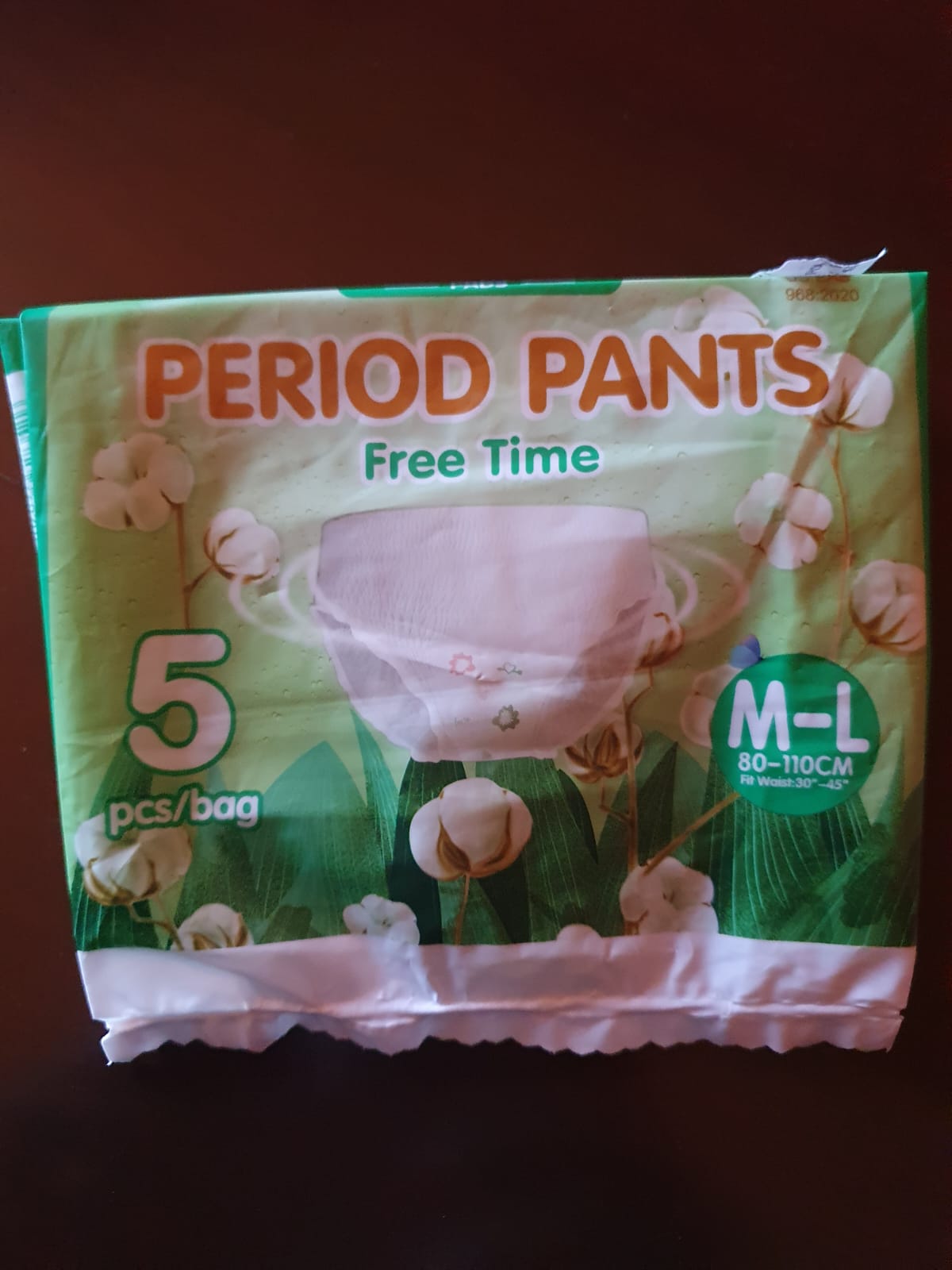
The new product, “Period Pants, Free Time”, combines the practicality of underwear with the absorbency and protection of sanitary towels, offering a modern solution to period care.
Unlike conventional sanitary pads or tampons, the period pants are designed to be worn like regular underwear, with the added advantage of in-built absorbency subsequently addressing common concerns around menstrual health.
“We wanted to introduce into the market a menstrual product reliable enough for day use yet protective enough for night and long distance travel. With period pants there is no fear of staining at all,” Dr. Odhiambo said.
Each pant features an elastic waist that allows for a snug yet comfortable fit for women up to large sizes. In addition, each period pant is singly packed, making it discreet and hygienic to carry in a handbag, school bag, or pocket. By bringing reliability and convenience to menstrual care, Amogola and Dr. Odhiambo hope to empower women and girls to live their lives with freedom.
“Periods should not be a source of stress or discomfort. Many women face difficulties accessing proper menstrual products. Our aim is to create a product that is not only comfortable and reliable but also packaged in a way that promotes ease of handling and hygiene,” explained Amogola.
A single packet contains five individually wrapped pieces, retailing at 500 Kenya shillings only. The period pants are designed to be worn for hours without causing friction or moving out of place. This makes them ideal for school-going girls, working women, or anyone with an active lifestyle.
Through their collaborative efforts, Amogola and Dr. Odhiambo have designed and produced a menstrual product that has been tested and truly lives up to its name—free time during menstruation.
The disposable period pants, which are now available in the market, have been hailed as a step forward in breaking taboos around menstruation and empowering women with choices that align with their lifestyles.
The product can now be purchased online and has a 1-3 day delivery service for buyers across Kenya. For purchase inquiries, interested customers can reach out via 0720 962 433 or 0718 181 924.
Workers in a Chinese managed construction site located along Hilltop road, Oloolua Ward, Kajiado North arrived at work yesterday morning 4th December 2025, only to discover the lifeless body of the site’s night watchman.
The legal identity of the body is yet to be released to the public but construction workers told Elveza Media the deceased is a native of Samburu county and claimed to have moved to Kajiado county in search of employment.
According to our sources who wished to remain anonymous for security reasons, the gang of thieves also injured another second guard before stealing construction equipment.
“The gang took their time well! They attacked the guard at around midnight and packed the equipment into an alleged waiting vehicle until 5am in the morning.” The source who wished to remain anonymous said
Those managing construction sites have been urged to beef up security, install enough lighting and ensure the safety of security guards is also considered.
The Kenya’s private security industry is regulated by the private security regulation act, 2016 and the private security (general) regulations. The enforcement of the regulatory framework, is a mandate of the Private Security Regulatory Authority (PSRA)
Security guards in Kenya are banned from carrying firearms but security firms are mandated to provide protection tools such as good torches, pepper sprays, stab vests and communication devices.
The welfare of the guards is well captured in the regulatory framework. Employers must ensure that guards have essential amenities such as the toilet while on duty and are remunerated well financially and in accordance to the employment laws of Kenya.
When Agrovoltaics (AV)—a method of growing crops under solar panels—was first introduced in Kenya in 2022 at Latia Agribusiness Solutions in Kajiado County, it began as a trial, with scientists and farmers hoping the project would improve agricultural production in the country’s Arid and Semi-Arid Lands (ASALs).
Three years later, the technology is proving its value, strengthening food production while providing a reliable source of renewable energy.
A collaboration between the University of Sheffield, World Agroforestry, and Latia Agribusiness Solutions, the project is demonstrating how solar panels can serve a dual purpose—generating electricity while optimizing crop-growing conditions.
The concept, often referred to as ‘Harvesting the Sun Twice,’ reduces heat stress on crops, minimizes water loss, and boosts overall yields.
“The agrovoltaics system has nearly halved our monthly electricity costs—from KES 150,000 to KES 80,000,” said Charles Macharia, the manager at Latia Agribusiness Solutions.
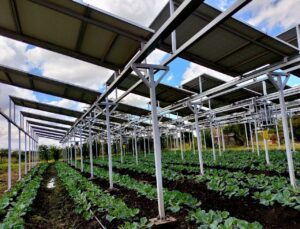
Crops growing under agrovoltaic system at Agribusiness Solutions, Kajiado.
Beyond reducing energy expenses, Macharia noted that the system is playing a crucial role in water conservation—an essential advantage in Kajiado’s dry climate.
“The solar panels are designed with gutters that collect rainwater, which we store in tanks for irrigation,” Macharia said, “This has significantly cut our reliance on other water sources and lowered irrigation costs.”
At the Latia farm, 180 solar panels, each generating 345 watts, are elevated three meters above the ground. This design allows sufficient sunlight and rainwater to reach the crops while shielding them from extreme temperatures.
The institution has observed improved growing conditions for maize, lettuce, kale, eggplant, and cabbage.
“Preliminary observations suggest that crops grown under the solar panels are healthier and more robust compared to those in open-field control plots, even when provided with the same amount of fertilizer and water,” said Judy Wairimu, an agronomist at Latia Agribusiness Solutions.
“For example, cabbages grown under the panels have been recorded to weigh up to five kilograms, whereas those in open fields typically reach around two kilograms,” she added, noting that the difference may be due to reduced heat stress, improved soil moisture retention, and more stable temperature conditions.
Agrovoltaic system at Latia Agribusiness Solutions, Kajiado.
Latia is not only implementing agrovoltaics on its farm but also training farmers across Kenya on its benefits and practical applications.
Anne Watkins, a farmer from Kajiado county is among those who have undergone training.
“I never imagined solar panels could help with farming,” she said. “Now I understand how they reduce heat stress on crops and save water. I plan to try this on my farm, ” Watkins said
However, Anne Watkins says the initial capital required to install the agrovoltaics system is a challenge that has limits farmers who want to adopt the system.
“The cost of installing the agrovoltaics system is too high for many farmers like myself . The government can assist by providing low interest loans to groups of farmers to enable them to install it and reap its benefits,” added Watkins.
Dr. Richard Randle Boggis, a research associate at the University of Sheffield, pointed out the need for localized testing of agrovoltaics to assess its potential in strengthening climate resilience and improving food security, particularly in rural and ASAL regions.
“We needed to build a test system to see if this technology is suitable for the region,” Dr. Boggis said during a field visit at Latia Agribusiness.
A study published in Nature – a scientific journal— showcases agrovoltaics as a promising solution for land-use efficiency, suggesting that dedicating just 1% of the world’s arable land to solar energy production could meet global energy demands.
Agrovoltaic farming system, is slowly gaining traction in Kenya. Aggie Konde from the Alliance for Green Revolution in Africa has said that there is growing interest in integrating renewable energy technologies into Kenya’s agricultural sector to enhance productivity and promote sustainability.
“Over the last twenty to thirty years, players that have been in the agricultural ecosystem have put the foundation on why agribusiness is viable for the continent. We know which technologies have a chance of success on the continent,” said Konde.
While Latia Agribusiness Solutions was the first to implement the technology, a second project—the Ngomano Agrivoltaic Project in Makueni County—has also adopted the approach. Though still in its early stages, this expansion reflects a growing interest in solar-farming systems as a way to boost agricultural productivity and renewable energy access, creating new opportunities for farmers across Kenya.
Initial trials at Ngomano have yielded promising results. According to Eytan Hatzor, a representative from Israel’s Agency for International Development Cooperation -also known as MASHAV- tomatoes, okra and cabbages grown under the shade of the solar panels have produced better yields in comparison to those grown in the open fields.
In addition, local farmers in Ngomano have been able to grow crops through irrigation using water collected through the agrovoltaic irrigation system.
“One of the reasons we started the project in the area is because the local community is taking part. They have their own field and get the advantage that part of the project is to bring water. The project has also combined production of electricity through solar energy with agriculture,” said Hatzor.
The Ngomano project was launched through the collaboration of the Jewish National Fund-USA, the University of Arizona and the Kasser Joint Institute for Food, Water, Energy, and Security in Arava Valley, Israel.
Ngomano agrivoltaic project in Makueni county
Hatzor has said that although the project has great potential for successful implementation in semi-arid areas like Makueni, initial installation cost is a challenge.
“Agrovoltaics has been successful in countries like United States of America. However, there are some improvements that can be made to reduce the installation costs. It is important to determine if the increased yields will cover the installation costs,” added Hatzor.
At Latia, the agrovoltaic system is currently powering farm operations, and its success in the dedicated section of land has sparked discussions about expansion.
According to the institution’s manager, the plan is to scale up the system to supply energy to the entire institution while incorporating solar energy storage as a backup for power outages.
“With sixty acres of land still available, expanding our agrovoltaic system will help us meet our growing farming and energy needs,” Macharia said.
This story was produced with the support of the African Centre for Media Excellence (ACME) in partnership with the Charles Stewart Mott Foundation
Police are investigating a possible stupefying incident that happened this week in Ngong.
Workers at a local petrol station noticed a young woman had fallen asleep while seated in the station cafe area for quite sometime. They attempted to wake her up but she failed to respond.
The station manager contacted the local police who responded and took her to Ngong Sub County Hospital. According to our source, the young woman who has been identified as a nurse in a Nairobi located Hospital and lives with her mother in Matasia.
CCTV footage obtained from the petrol station captured the young woman alighting from a 111 route ‘matatu’ heading towards Ngong Town that afternoon in the company of man suspected to be middle aged. The cameras also captured the two seating in the station cafe area before the male companion leaves and boards another ‘matatu’ heading towards Ngong Town.
When the police arrived at the scene, they unsuccessfully attempted to wake her up. According to our source, the mother came to know about her daughter’s situation after she called her after being concerned over her unusual lateness that day. A nurse at Ngong Sub County Hospital answered the phone and broke the news to the mother. The nurse is said to have started regaining her consciousness at around 4am that night.
On 1st January, another middle aged man claimed to be a resident of Matasia was found sleeping in his vehicle which was parked in Ngong. After being woken by concerned members of the public, the man who had wet himself woke up confused and unaware where he was. A member of the public contacted the man’s spouse who came and picked him.
In Kenya, stupefying is a felony offense under Section 230 of the Penal Code. It is defined as administering or attempting to administer a stupefying or overpowering drug or thing to someone with the intent to commit or facilitate a felony or misdemeanour. The maximum penalty for stupefying to commit a felony is life in prison.
Fraudulent trade misinvoicing in Kenya, East Africa’s biggest economy, increased during the COVID-19 pandemic while customs workers were in lockdown or laid off, a closely-watched report by a research group that exposes financial corruption is likely to reveal, according to its chief executive.
Tom Cardamone, who heads the Washington-based Global Financial Integrity (GFI), said the group would release updated research on trade misinvoicing in early 2025, its first comprehensive assessment since the pandemic.
Trade misinvoicing is a way to move money across borders by falsifying the value, quantity or quality of goods on invoices. Under-invoicing of exports is the main method of shifting money illicitly out of the country and under-invoicing of imports is used to illegally smuggle money into the country. Exports and imports are booked at different values to avoid taxes or to hide large transfers of money across borders.
“Overall, while the amount of misinvoicing can fluctuate from year to year there is little evidence to indicate the amount of misinvoicing is on a downward trend,” Cardamone told Elveza Media.
“My guess, and it is just a guess, is that misinvoicing worsened during Covid because of staff shortages, which made it more difficult to identify misinvoicing when it occurs,” he said. Cardamone did not offer statistics to back up his statement but noted: “We will know more as we dig into the data.”
Tax Justice Network Executive Director, Alvin Mosioma, said it was likely that a surge in illicit financial flows, including from trade misinvoicing, during the pandemic was due to a lack of oversight and increased corruption at the country’s borders.
“Covid-19 disrupted the way of doing things,” said Mosioma. “There are concerns of an increase in the scale and scope of illicit financial flows.”
A study by GFI in 2014, which looked at the impact on revenues from trade misinvoicing in five African countries between 2002 and 2011, estimated that Kenya lost roughly $435 million annually in tax revenue during that period from trade misinvoicing, the equivalent of 8.3% of total government revenue.
To put it in perspective, the losses are seven times the $60.8 million 2024/25 budget of the Inua Jamii Programme, which benefits over 1.5 million orphans and elderly persons in the country.
Tackling the trade misinvoicing problem will be crucial as public pressure grows on the government of President William Ruto to deal with corruption and government waste. Fifty people died in protests by Kenyan youths in June after the government tried to push through tax increases to improve government finances. Ruto fired most of his cabinet and invited the International Monetary Fund to conduct an in-depth assessment of how corruption and mismanagement of state resources is draining public finances.
Cardamone said most countries failed to report their trade transactions between 2020 and 2022, the period most impacted by the epidemic when factories were forced to close and global trade was powering down across the globe. In Kenya, trade volumes declined to $16.9 million in 2020 from $18.5 million in 2019 due to a drop in imports, according to the Kenya National Bureau of Statistics Economic Survey report in 2021.
COMPLACENCY AND CORRUPTION
Charles Njonjo, a trade expert and financial consultant in Kenya, blamed trade loopholes for Kenya’s losses from trade misinvoicing, especially in the agricultural and mining sectors.
“The amount of money Kenya loses because of transfer pricing and misinvoicing continues to increase every year because of complacency and corruption by government officials, who have been pocketed by multinational corporations,” said Njonjo. “Some multinational companies produce two separate invoices to evade taxes but this is overlooked by government officials who have been compromised,” he added.
There have long been questions around the profits – and losses – in Kenya’s flower industry, one of the world’s largest exporters of cut stems. In 2011, the head of domestic taxes at the Kenya Revenue Authority, John Njiraini, launched an investigation into the flower sector, including into the three largest multinational producers Oserian, Karuturi and Flamingo on suspicions of shifting profits to other jurisdictions.
In 2016, Karuturi multinational flower farm was forced to close after being found guilty by a Kenyan court for evading $11 million in taxes. Njonjo, the trade expert, said Karuturi evaded taxes by transfer pricing and misinvoicing the cost of imports of supplies to their flower farms in Kenya.
“The company was domiciled in India, the flower farms were in Kenya, and the market is in the Netherlands,” he explained. “Karuturi sold the flowers to the Netherlands and the money was sent to India. Karuturi also supplied fertilisers and pesticides from India to Kenya at exaggerated prices, which made it impossible for their branch in Kenya to make profits,” he added.
A 2023 International Narcotics Control Strategy report by the U.S. State Department’s Bureau for International Narcotics and Law Enforcement Affairs blamed Kenya’s weak regulatory and supervisory frameworks, poor compliance, weak human capacity, and lack of transparency in the financial system for the country’s trade misinvoicing problem.
The National Taxpayers Association lobby group said Kenya’s grey-listing by the Financial Action Task Force(FATF) in February 2024 because it lacked a clear strategy for prosecuting money laundering offences.
GOING AFTER THE WRONGDOERS
Wambui, a lawyer and founder of Sheria Mtaani na Shadrack Wambui, a law firm providing free legal representation to vulnerable people, said the lack of clear legal guidelines when dealing with fraudulent companies, as well as ability of companies involved in economic crimes, makes it easy for them to avoid prosecution.
“It is easier to prosecute individuals than companies,” said Wambui. “There are laws, including the Anti-corruption Act and Proceeds of Crime Act, that are meant to deal with corruption, but people involved in corruption find ways to avoid prosecution by forming other companies,” he added.
In the most recent Mutual Evaluation Report of Kenya, published in September 2022, out of a total of 335 tax offences there were only 62 convictions.
Kenya has put in place some measures to fight illicit financial flows, however, these mechanisms have not been effectively used by the authorities, according to the anti-money laundering and counter-terrorist financing measures published in 2022.
In March 2023, the Kenya Revenue Authority, or KRA, changed the tax structure to deal with loopholes that have led to misinvoicing through underinvoicing, which causes fewer payments of Value Added Tax, or VAT, and customs duties due to the lower valuation of goods.
To further help detect tax evasion, the KRA launched “GAVA Connect”, a digital tool Ruto said would help improve efficiency and transparency within the tax system.
This story was written as part of Wealth of Nations, a pan-African media skills development programme supported by the Thomson Reuters Foundation as part of its global work aiming to strengthen free, fair and informed societies. Any financial assistance or support provided to the journalist has no editorial influence. The content of this article belongs solely to the author and is not endorsed by or associated with the Thomson Reuters Foundation, Thomson Reuters, Reuters, nor any other affiliates. More information at www.wealth-of-nations.org
For the first time, Nancy Mugure is comfortable during her menstruation. For Mugure, the launch of the Inclusifit menstrual underwear in June 2024 has transformed not only her life but the lives of intersex persons who menstruate like herself. Mugure, who has used the menstrual boxer for over six months, notes that the sanitary products available in the Kenyan market did not cater to her menstrual needs as an intersex person who menstruates, but the undergarment has been able to fill this gap.
“I love Inclusifit because it secures all my private parts, unlike other sanitary products, which leave part of them uncovered. I am able to walk comfortably because the fabric is soft, absorbent, and does not leave an odour. When I used the sanitary towels that are available in the market, the menstrual flow would leak because I wasn’t fully secured,” said Mugure.
The menstrual boxer is made of a soft cotton and spandex fabric and lined with three layers of different materials to make it highly absorbent.
“I now use one menstrual boxer per day during my monthly periods. It is washable and takes less than thirty minutes to dry. I hang it outside in the shade to increase its durability. Also, I keep watch to prevent theft and people from touching it, ” added Mugure.
Prior to using the underwear, the fear of menstrual blood leaking in public, coupled with the societal stigma around menstruation still faced by women and girls in Kenya today, forced Mugure to isolate for several days during her monthly period. Her withdrawal from normality negatively impacted her quality of life.
“My mental health was affected because of the stigma, discrimination and embarrassment in case of a menstrual leak on my trousers became apparent. You see, I’m an intersex person who physically presents as a male. When I was in high school, I missed most classes during my periods. I even had to sit my mathematics paper during the national examinations in the dormitory,” recounts Mugure.
Laura (not her real name) is an athlete who is also experiencing the convenience and practicality offered by Inclusifit. The underwear has given her new freedom and a sense of normalcy to pursue her sports career.
“I take part in high jump as well as 400 and 800 metres races and I find it comfortable enough to use even during my sports activities, says Laura. “I use one menstrual boxer for up to eight hours. Previously, I would have to change sanitary towels every two hours. For the reserved athlete, the last four months have brought a new sense of confidence to their sport.
Frank Kibagendi from the Jinsiangu organisation, which advocates for safe spaces for intersex persons, champions the Inclusifit underwear, which was launched in partnership with Kenya National Commission for Human Rights (KNHCR) and Virtuous, a brand specialising in period underwear. The initiative was spurred in 2023 after research by Jinsiangu and Amka Africa Justice Initiative, a non-profit providing access to justice for the poor, minorities and marginalised groups, found out that 30 out of 41 intersex persons who menstruate reported that there is no menstrual product in the market which meets their needs.
Inclusifit retails for 500 to 2500 Kenya shillings on the Jinsiangu, Virtuous, and Inclusifit websites. However, the menstrual boxer is currently unavailable in supermarkets, making accessibility a challenge.
Launch of the Inclusifit menstrual underwear.
Kibagendi admits that limitations in accessibility and pricing are barriers to more intersex people benefiting from the underwear. “As an organisation, we are trying to make sure we produce more menstrual boxers so we can reach more intersex people across the country. We are also working towards developing other gender-inclusive products and making Inclusifit cheaper and more affordable. My appeal to the government is to help us in financing the production of these products so that we can give them out to school-going intersex children,” says Kibagendi.
It is encouraging for members of the country’s intersex community that strides are being made towards more visibility and inclusivity, unlike for other sexual minorities. This is evident with the inclusion of the third gender marker for the first time during the 2019 census and now with the proposed Intersex Persons Bill 2024, which is currently at the public participation stage.
The bill seeks to make it illegal to discriminate against intersex persons in the areas of employment, education, and accessing health care, including mental health services.
For the extroverted Mugure, there is still a great need to improve the accessibility of the undergarment so that other intersex persons who menstruate can benefit from the security and practicality that it offers. “Unfortunately, many intersex persons in Kenya are still forced to stay at home during menstruation, but if the menstrual boxer reached them, this could be a thing of the past.
“Personally, it has been life-changing,” asserts Mugure.
Chess players from teams across Kenya have participated in the Kenya National Chess league at the Cooperative College in Ongata Rongai town. The chess league was organized by Chess Kenya Federation with the support of the Kenya Commercial Bank (KCB).
Speaking at the league, Kenya National Chess League secretary Antony Kiunga has said the chess event is comprised of teams from the premier league and super league.
“Today, we are having the second last fixtures of the league. At the end of the season, the top three teams in the super league will be promoted to the premier league which comprises of elite players in the country, ” said Kiunga.
Chairman of the Kajiado County Chess Association Victor Hongo has reiterated the importance of chess in enhancing life skills for players of the sport.
“This event has attracted players from counties including Mombasa, Kiambu, Kisumu and Kajiado. Chess is a wholesome sport with benefits like improving critical thinking, problem solving and planning skills, ” said Hongo.
According to Hongo,who has over ten years experience in chess, the sport has gained popularity across Kenya because of its educational value with more schools embracing the sport.
“There are over one hundred players and twenty-five teams in this league. Also, more schools are now getting involved in chess. The number of players annually in the regional qualifiers has increased from two thousand to six thousand and I anticipate the numbers could rise to ten thousand by next year, ” Hongo added.
In efforts to promote chess in Kajiado county as well as improve its standards, Kajiado County Chess Association will host a chess camp for children between 25th and 30th November.
The benefits of the chess camp will include coaching professional chess coaches in preparation for the upcoming chess national championships and regional qualifiers.
The ongoing chess league will be concluded on 1st December and winners in both the premier and super league will receive a cash prize.
Women in Nairobi county who cannot afford the hefty sum of 1500 Kenya shillings for mammograms and pelvic ultrasounds are being forced to miss out on the life-saving routine check-ups.
These critical routine check ups that are used in the early detection of breast, ovarian and cervical cancers, have become inaccessible to low and middle income women after the introduction of new charges across level 5 hospitals through the Nairobi County Finance Bill,2023.
In efforts to further increase collected revenue, the Nairobi County Finance Bill 2023, further introduced a new charge of 1000 Kenyan shillings across level 5 hospitals for pap smear tests which is used to detect cervical cancer.
In a statement issued by the National Taxpayers Association, the lobby group has called on the government to exercise fairness in revenue collection as well as in the use of collected revenue.
The executive director of the National Taxpayers Association Irene Otieno has said that over the years, the government has put in place measures to increase revenue collection but has cited the need to include taxpayers in decision making on revenue collection as well as accountability on the use of collected revenue.
Ms Irene Otieno – NTA National Coordinator
The National Taxpayers Association (NTA) has urged the government to adopt a more equitable approach to revenue collection and utilization. NTA National Coordinator Ms Irene Otieno emphasized the importance of involving taxpayers in decision-making processes to ensure transparency and accountability. While acknowledging the government’s efforts to increase revenue, Irene highlighted the need for fairness and efficiency in both taxation and expenditure.
“We have been looking at the tax raising measures that the government has been developing. Our concern is where the voice of the citizens is in our tax raising endeavors. As a country we need to raise domestic resources to finance and provide essential services but we need to look into how we are raising this revenue as well as how we can redistribute this revenue.”
According to the World Health Organization,30-50% of cancers can be reduced through early detection including screening. Cervical cancer is the leading cause of cancer-related deaths among women in Kenya, accounting for an estimated 3,211 deaths annually. In addition, breast cancer accounts for 23% of all cancer cases among women in Kenya.
Article 43 of the constitution guarantees the right to the highest attainable standard of health including reproductive healthcare. However, according to the National Policy on Gender and Development 2019, inequality, inaccessibility, unacceptability, and unaffordability of quality health services are the main barriers to the achievement of the highest attainable standard of health for women in Kenya.
Kenya’s healthcare system continues to grapple with the issue of gender inequality, which disproportionately affects low and middle income women who experience financial barriers to cancer screening in a health facility.
Institute of Public Finance (IPF) has called on all counties in Kenya to implement gender responsive budgeting to ensure equitable economic, social, political and cultural development for both men and women.
Legal officer at IPF Daniel Murakaru has said that out of five counties IPF visited during the implementation of the gender responsive budget programme including Machakos, Kitui, Kwale, Kisumu and Busia it was observed that only Kisumu county had a gender mainstreaming policy which is required in the implementation of a gender responsive budget.
Daniel has said counties are mandated by Article 27 of the Constitution of Kenya to incorporate gender initiatives in their budgets to ensure gender responsive budgeting as a measure towards promoting equality of men and women and addressing past injustices.
“We have found that counties rarely use gender responsive budgeting as a tool in developing their budgets. Some counties even lack gender policies which are the foundation of gender responsive budgeting. The constitution and the principles of public finance states that expenditure is supposed to ensure equitable development including making provisions for marginalised groups.”
According to Daniel, gender responsive budgets are aimed at increasing the efficiency of national and county budgets by raising awareness on the different needs of men and women as well as raising government accountability on revenue collection and expenditure.
“Gender issues have to be addressed in the policies to address existing gender inequalities between women and girls as well men and boys in recognition that males and females have different needs. The Finance Bill 2024 that was withdrawn introduced the eco- levy on pads and diapers which had a negative impact on menstrual health of women and children using diapers.”
Project officer at the National Taxpayers Association(NTA) Boniface Karanja has reiterated the importance of adopting a gender responsive budget at the county and national levels to address gender gaps and it’s subsequent impact on the taxpayers.
“All aspects of budgeting should address the needs of each gender to ensure inclusivity and fairness of both men and women in revenue raising measures. We need to take initiatives to ensure that gender inequality gaps are sealed so that no group is more marginalised than the other.”
Section 6 of Article 27 of the Constitution of Kenya guarantees that the government shall take legislative and other measures, including affirmative action programmes and policies designed to redress any disadvantage suffered by individuals or groups because of past discrimination.